










-250x250w.jpg "GAUZE ROLL Egypt size 7 cm")
-250x250w.jpg "compress with cover")




about product
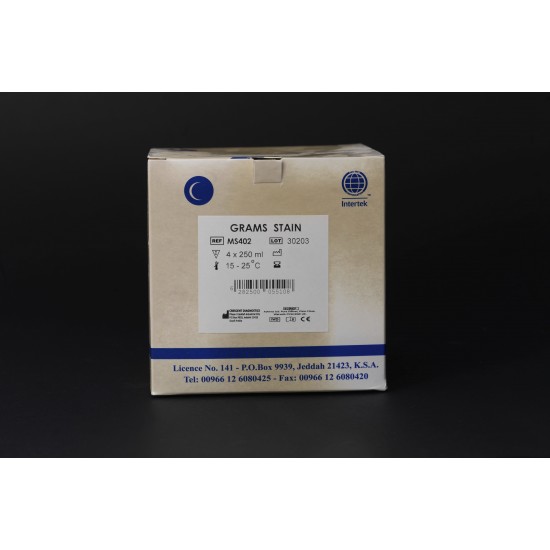
Gram Stain is a staining technique used in microbiology to classify bacteria into two main groups: Gram-positive bacteria and Gram-negative bacteria. This classification is based on the properties of the bacterial cell wall, which helps in identifying the type of bacteria and determining the appropriate treatment.
Description:
- Gram-Positive Bacteria: These bacteria absorb the crystal violet stain and remain purple after the application of iodine and alcohol.
- Gram-Negative Bacteria: These bacteria do not retain the crystal violet stain after washing with alcohol, and instead turn red after the addition of the counterstain, safranin.
Steps of Gram Staining:
- Application of Crystal Violet Stain: The sample is immersed in crystal violet stain for a set time, allowing the bacteria to absorb the color.
- Application of Iodine: Iodine acts as a mordant, fixing the crystal violet dye to the bacteria.
- Alcohol Wash: The sample is washed with alcohol to differentiate between Gram-positive and Gram-negative bacteria.
- Application of Safranin Stain: Safranin is used to counterstain Gram-negative bacteria, turning them red.
Uses:
???? Bacterial Classification: Gram Staining helps classify bacteria based on the properties of their cell walls. ???? Medical Diagnosis: It helps doctors identify the type of bacteria causing an infection and guide appropriate treatment. ???? Scientific Research: Researchers use this technique to study bacteria in laboratory settings.
Advantages:
✅ High Accuracy: It helps in the precise classification of bacteria. ✅ Quick Diagnosis: Provides rapid results, aiding in selecting the correct treatment. ✅ Helps in Antibiotic Resistance Determination: Identifies bacteria types, assisting in the choice of effective antibiotics.
- Stock: 4
Gram Stain is a staining technique used in microbiology to classify bacteria into two main groups: Gram-positive bacteria and Gram-negative bacteria. This classification is based on the properties of the bacterial cell wall, which helps in identifying the type of bacteria and determining the appropriate treatment.
Description:
- Gram-Positive Bacteria: These bacteria absorb the crystal violet stain and remain purple after the application of iodine and alcohol.
- Gram-Negative Bacteria: These bacteria do not retain the crystal violet stain after washing with alcohol, and instead turn red after the addition of the counterstain, safranin.
Steps of Gram Staining:
- Application of Crystal Violet Stain: The sample is immersed in crystal violet stain for a set time, allowing the bacteria to absorb the color.
- Application of Iodine: Iodine acts as a mordant, fixing the crystal violet dye to the bacteria.
- Alcohol Wash: The sample is washed with alcohol to differentiate between Gram-positive and Gram-negative bacteria.
- Application of Safranin Stain: Safranin is used to counterstain Gram-negative bacteria, turning them red.
Uses:
???? Bacterial Classification: Gram Staining helps classify bacteria based on the properties of their cell walls. ???? Medical Diagnosis: It helps doctors identify the type of bacteria causing an infection and guide appropriate treatment. ???? Scientific Research: Researchers use this technique to study bacteria in laboratory settings.
Advantages:
✅ High Accuracy: It helps in the precise classification of bacteria. ✅ Quick Diagnosis: Provides rapid results, aiding in selecting the correct treatment. ✅ Helps in Antibiotic Resistance Determination: Identifies bacteria types, assisting in the choice of effective antibiotics.